


Who Were The Philistines and What About Palestine?

Updated: Apr 7
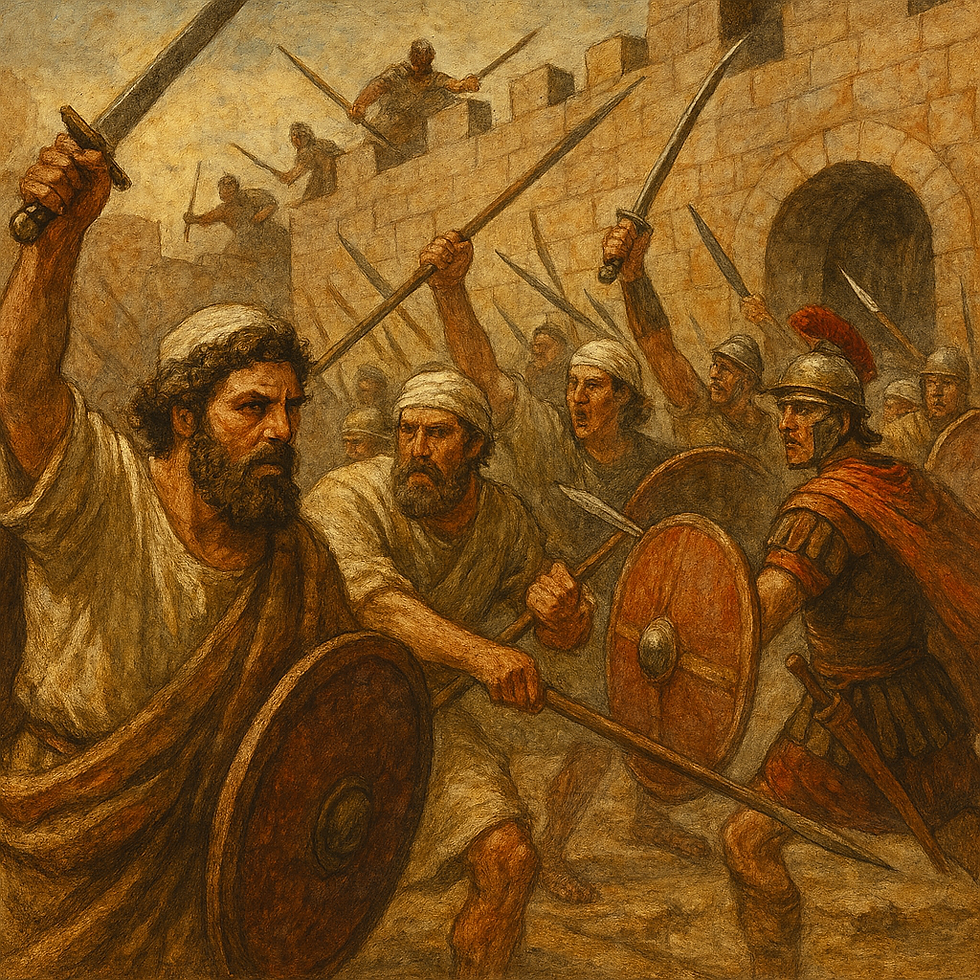
The Philistines appear throughout Scripture as Israel’s persistent adversaries, yet their story is far richer than simple conflict.
Who settled the disputed land first? Long before the Philistines arrived, the land was already inhabited by Canaanite peoples who had lived there for centuries. The Israelites entered the land during the Late Bronze Age, sometime between 1400 and 1200 BCE, while the Philistines arrived later, around 1175 BCE, during the collapse of the Bronze Age world. This means the Israelites were already present when the Philistines settled along the southern coast.
The Abimelech encountered by Abraham and Isaac (in Genesis) was not one of the later Aegean Philistines. As the Times of Israel notes, “calling him a ‘Philistine’ is a major anachronism, since the historical Philistines did not arrive until the 12th century BCE. Abimelech was a local Canaanite ruler bearing a dynastic title, not a member of the later Sea Peoples.” (4)
Archaeology and historical sources show that the Philistines came from the Aegean region, the world of early Greek culture. The Aegean includes mainland Greece, the Greek islands, Crete, and the western coast of Anatolia. This area was home to the Mycenaean civilization, whose pottery, architecture, and artistic patterns match what is found in early Philistine sites. They were part of a migratory group referred to as “Sea People”. One of the Sea People groups were called the “Peleshet”, which is the origin of the name “philistine”. The name Peleshet means “immigrants”, “foreigners”, “invaders” according to Hebrew and Egyptian sources.
Amos 9:7 alludes to these sea-faring peoples:
“Have I not brought up Israel from the land of Egypt, and the Philistines from Caphtor…”
Their arrival in Canaan was part of a larger migration of “Sea Peoples,” recorded in Egyptian inscriptions, who moved across the Mediterranean during a time of upheaval. Egyptian records indicate that a group of the Sea People attacked them and were defeated. The Peleshet were settled by Ramses III on Egypt’s northern border. So, that’s how they came to be in the region, on the southern coastland of what would later be Israel, but was first Canaanite territory.
Rather than forming a single unified nation, the Philistines lived in a confederation of five independent city-states - Gaza, Ashkelon, Ashdod, Ekron, and Gath. Each city had its own ruler, known as a seren, and together they formed what Scripture and history call the Philistine Pentapolis. Their political structure functioned more like a league than a centralized kingdom, which explains the variation in their culture and the independence of their rulers.
Their language in the earliest period was likely Indo-European, related to the Aegean languages of their homeland. Over time, as they intermarried and interacted with the surrounding peoples, they adopted the local Semitic languages of Canaan. This is why later Philistine names and inscriptions appear Semitic rather than Greek, they had gradually assimilated into the region.
Egyptian reliefs depict the Philistines with light to medium skin tones, feathered headdresses, and Aegean-style clothing, consistent with their Greek-related origins. Their appearance reflects the broader Eastern Mediterranean world rather than the Semitic populations around them.
The Philistines eventually disappeared as a distinct people. The prophet Amos 1:8 tells us:
I will also cut off the inhabitant from Ashdod, and him who holds the scepter, from Ashkelon; I will even unleash My power upon Ekron, and the remnant of the Philistines will perish,” Says the Lord GOD.”
This happened when they were conquered by the Neo-Assyrian Empire and later destroyed by Nebuchadnezzar II in 604 BCE. By the sixth century BCE, they no longer existed as a separate ethnic group. They have long been lost to the pages of history.
So, if they have not existed for about 2600 years, then why do we keep hearing the term “Palestine” all the time? Here is why-
In 135 CE, Rome crushed the Bar Kokhba revolt (under Emperor Hadrian) and deliberately renamed Judea as “Syria Palestinia”, or in English Palestine. Hadrian invoked the ancient Philistines as a symbolic act meant to sever Jewish identity and connection to the land. The name had nothing to do with surviving Philistine people - there were none. They had long disappeared. It was a political erasure of Israel, not an ethnic continuation of Philistines. There was NEVER a nation called “Palestine”. Guess what? There is no people group anywhere on earth called the “Caananites” either! Their remnants were absorbed and lost to the pages of history as well.
Notice that the Roman’s DID NOT name it Palestinia until after 135 CE. History records that Jews and Arabs that remained living in the land after this or those Jews returning to the land in the centuries following, were called Palestinians (because of Rome’s renaming). So, how is it then that so called “Palestinians” of today want to claim that Jews are “occupiers” of their land? They aren’t Philistines and even if they were- the Jews were there first.
Furthermore, before Emperor Hadrian did his re-naming, the land (a nation) was called Israel. In 1948 it became a nation again, Israel.
Understanding who the Philistines truly were - Aegean migrants who settled after Israel, lived in a five‑city confederation, assimilated into the region, and eventually vanished - brings clarity to Scripture and restores historical depth to the biblical narrative. Their story is a reminder that the Bible unfolds within real history, shaped by migrations, empires, and the sovereign hand of God guiding His people through every age.
Israel remains in their land - Philistines don’t! Canaanite’s don’t!
Leisa
References:
1. The Philistine Age. Archaeology Magazine, July/August 2022.
2. Historical Philistines: Record of Them and Where They Lived. Middle East & North Africa – Facts and Details.
3. Wikipedia – “Philistines.”
4. Kennemer, Daniel. “Who were the ‘Philistines’ in the time of Abraham and Isaac?” The Times of Israel, 2022.
5. Wikipedia – “Abimelech.”
6. Abimelech: The King of Gerar and the Patriarchs’ Deceptions. Bible Believing Christian.
7. Genesis 26 Commentary. United Church of God.
Standard biblical chronology placing
Abraham in the early 2nd millennium BCE (ca. 2000–2090 BCE).


Shalom Miss jika diijinkan sy mau menyalin artikel ini